
What is Aroon for?
Aroon (“dawn’s early light” in Sanskrit) was designed by Tushar Chande to spot the start of a trend. Its idea is original: instead of looking at how far price has moved, it looks at how long ago price reached its recent high and its recent low. In a real uptrend new highs keep appearing; in a real downtrend, new lows. Aroon turns that freshness into two numbers from 0 to 100.
How it is calculated
- It looks at the last 25 candles plus the current one (period + 1 candles) and finds the highest high and the lowest low of that window.
- Aroon Up = 100 × (period − number of candles since the high) ÷ period. It equals 100 if the high is the current candle, and 0 if it dates back 25 candles.
- Aroon Down = the same calculation with the low. If several peaks tie, the most recent one counts.
- Only the age of the extremes matters, not their height. Nothing is computed with the future, so the signal does not repaint. The indicator starts after 25 candles.
Reading the signal in Algo Signals
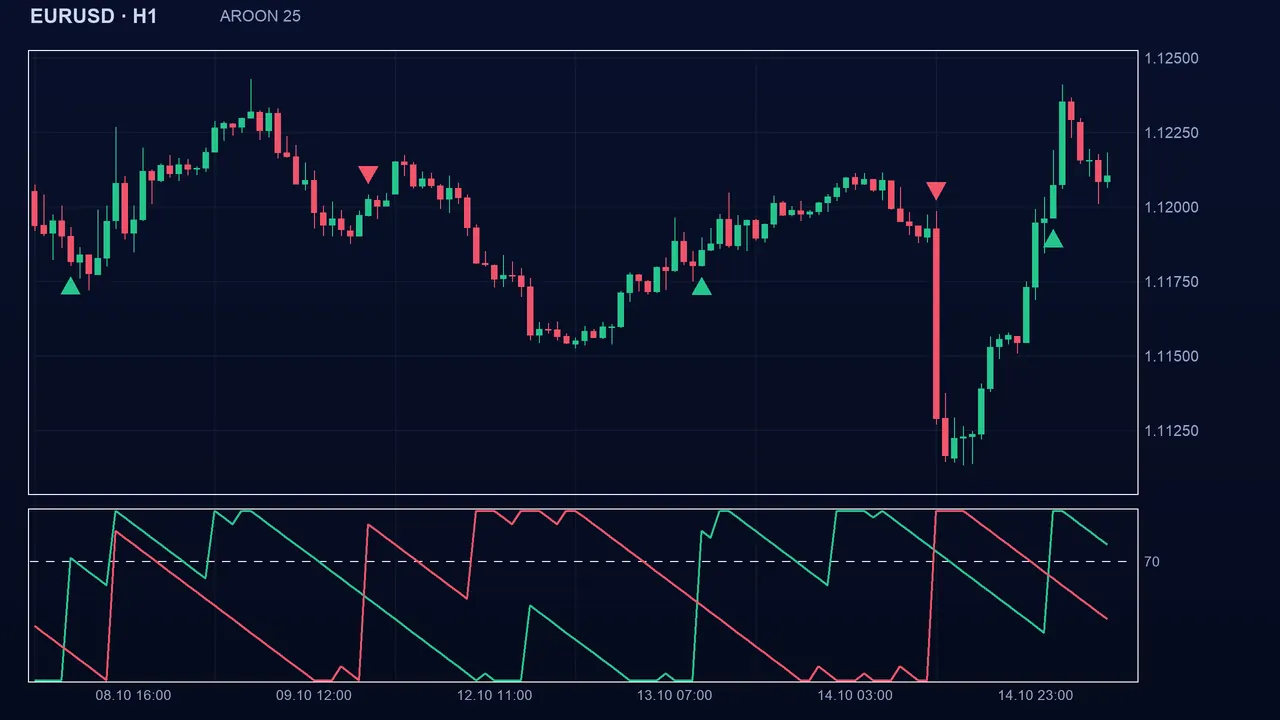
Buy: Aroon Up is greater than Aroon Down AND reaches at least the minimum level (70 by default). Sell: Aroon Down is greater than Aroon Up AND reaches at least 70. Otherwise the state is neutral. With 25 candles and a level of 70, this means the high must be at most 7 candles old: at 7 candles, 100 × (25 − 7) ÷ 25 = 72; at 8 candles, it drops to 68.
The settings
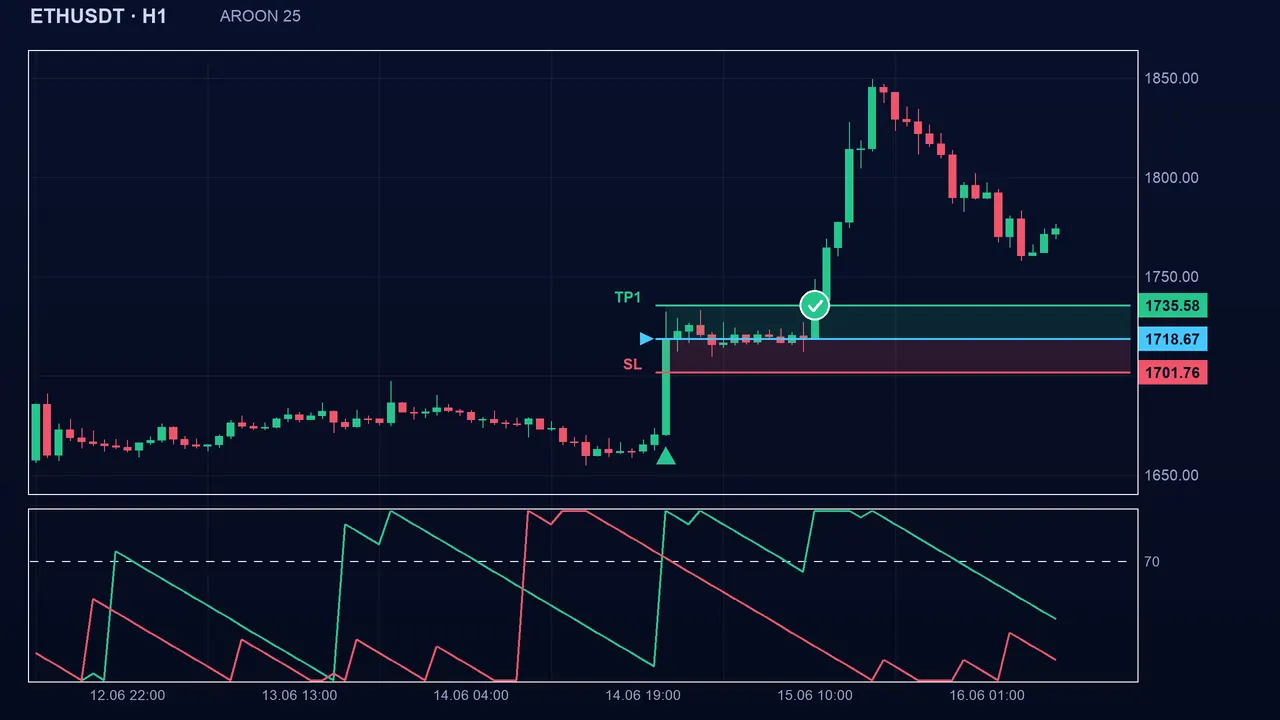
- Period: 25 by default (2 to 200). Shorter: Aroon reacts fast and changes its mind often. Longer: it follows big trends, but very late.
- Minimum Aroon level: 70 by default (50 to 100). Higher: a very recent peak is needed, so fewer but “fresher” signals. At 50, almost any situation where Aroon Up leads gives a signal.
- The values 25 and 70 are the author’s conventions, not proven optima.
The pitfalls
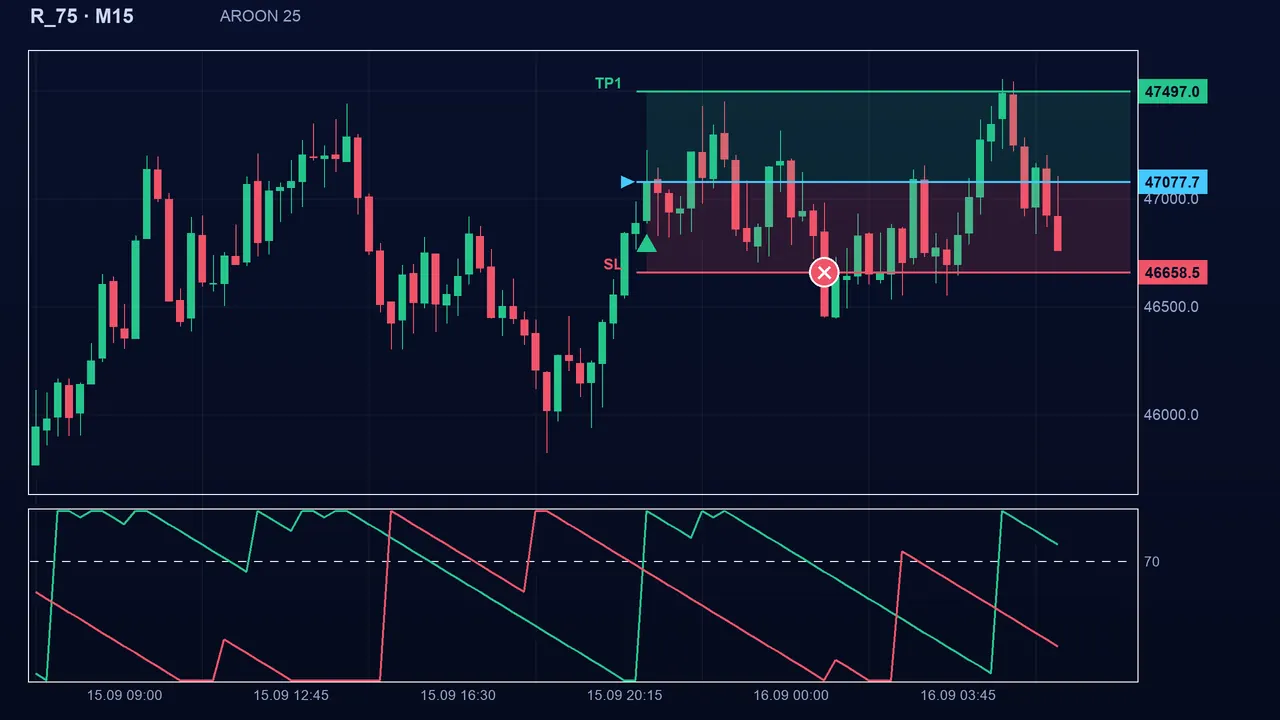
Aroon only looks at when the extremes happened, not at the distance travelled: a high barely above the previous one counts as much as a real surge. In a range market, the high and the low are both recent, and Aroon can still say “buy” as soon as one is slightly more recent than the other. On Boom/Crash, a spike instantly creates a brand-new high (or low) and flips Aroon in one go.
Key takeaways
- Aroon measures how old the high and the low are over 25 candles, not the distance travelled.
- Buy: Aroon Up > Aroon Down and Aroon Up ≥ 70. Sell: the opposite with Aroon Down.
- It spots the start of trends, but is fooled in a range where both extremes are recent.
- Default settings: period 25, minimum level 70.
📝 Lesson test
Log in to take this lesson’s test. Once you have passed all the tests, you will receive a certificate in your name.
Log inThese lessons are for understanding and are not investment advice. No method guarantees winning.