
What are pivot points for?
Every day, price seems to bounce off or stall at precise levels. Pivot points are levels computed in the morning from the previous session, and many traders watch them. Because they do not move for the rest of the day, they act as shared reference points: support zones, resistance zones, and a line separating a rather bullish market from a rather bearish one.
How they are calculated
Algo Signals takes the high (H), low (L) and close (C) of the previous completed period: the UTC day, or the UTC week if you set the period to 2. There is no look into the future: today’s levels depend only on yesterday. The very first loaded period, often cut short, is ignored.
- CPR (Central Pivot Range): pivot P = (H + L + C) / 3; BC0 = (H + L) / 2; TC0 = 2 × P − BC0. The upper edge TC is the larger of the two, the lower edge BC the smaller. A narrow CPR means yesterday’s close was near the middle of its range.
- Classic supports and resistances: R1 = 2 × P − L; S1 = 2 × P − H; R2 = P + (H − L); S2 = P − (H − L), plus R3, R4, S3, S4 further away. They are mostly used for targets.
- Camarilla: with range A = H − L, H3 = C + A × 1.1 / 4; H4 = C + A × 1.1 / 2; L3 = C − A × 1.1 / 4; L4 = C − A × 1.1 / 2 (H1, H2, L1, L2 also exist, with 1.1 / 12 and 1.1 / 6).
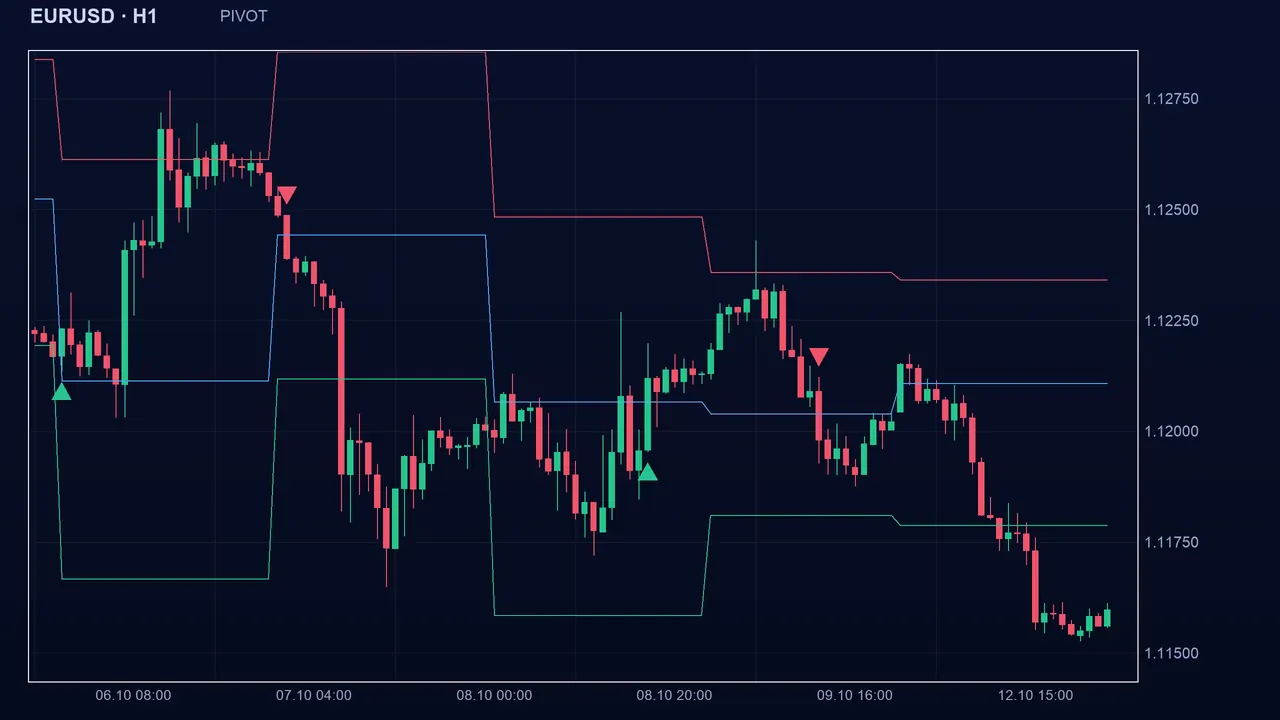
How to read the signal in Algo Signals
The “mode” setting chooses the reading: 1 = CPR (default), 2 = Camarilla, 3 = both. In CPR mode: a close above TC is bullish (buy); a close below BC is bearish (sell); a close inside the CPR is neutral. In Camarilla mode: a close beyond H4 or L4 is a breakout; a wick that touches L3 and then closes above L3 is a bounce (buy); a wick that touches H3 and then closes below H3 is a rejection (sell). The Camarilla state stays valid until the end of the period, then resets to zero. Mode 3 gives priority to Camarilla when it has spoken, otherwise to the CPR.
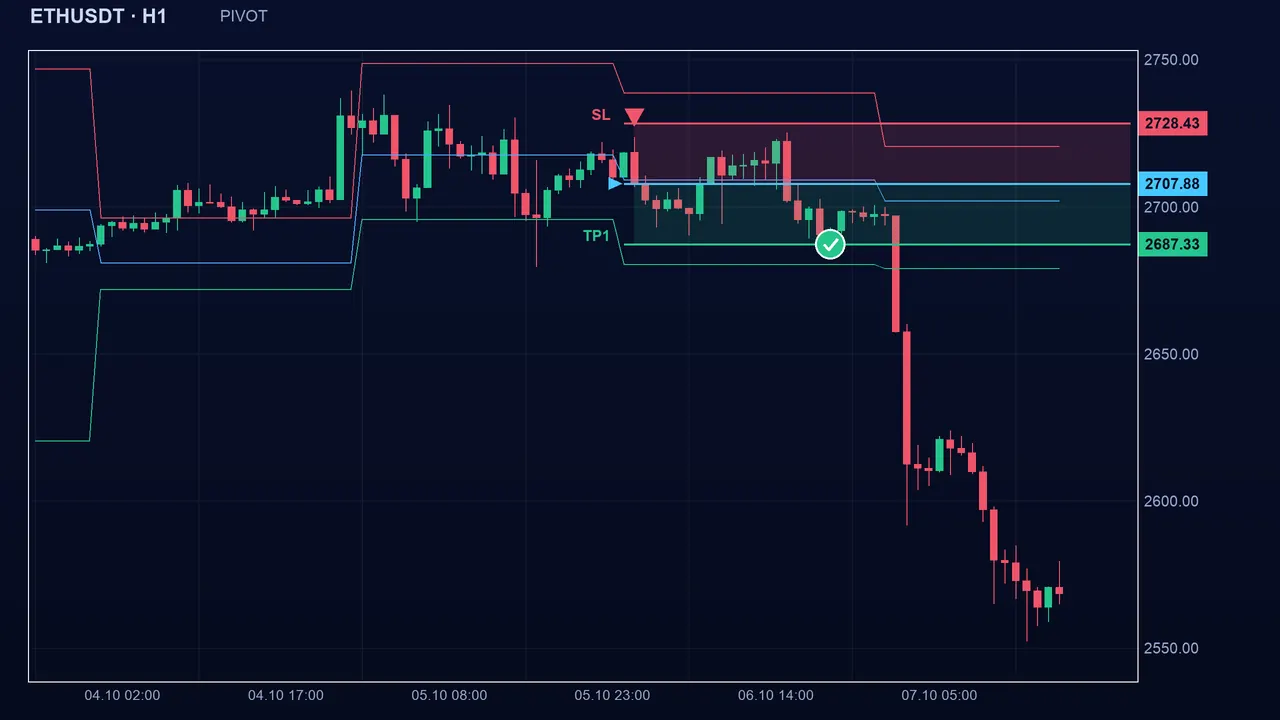
The settings
- Mode (default 1, from 1 to 3): 1 = CPR, 2 = Camarilla, 3 = both.
- Period (default 1, from 1 to 2): 1 = daily levels, 2 = weekly levels. Weekly levels are wider and change only once a week; daily ones adapt faster.
- The day is cut at 00:00 UTC, not at the New York close: your levels may differ slightly from another platform’s.
The pitfalls
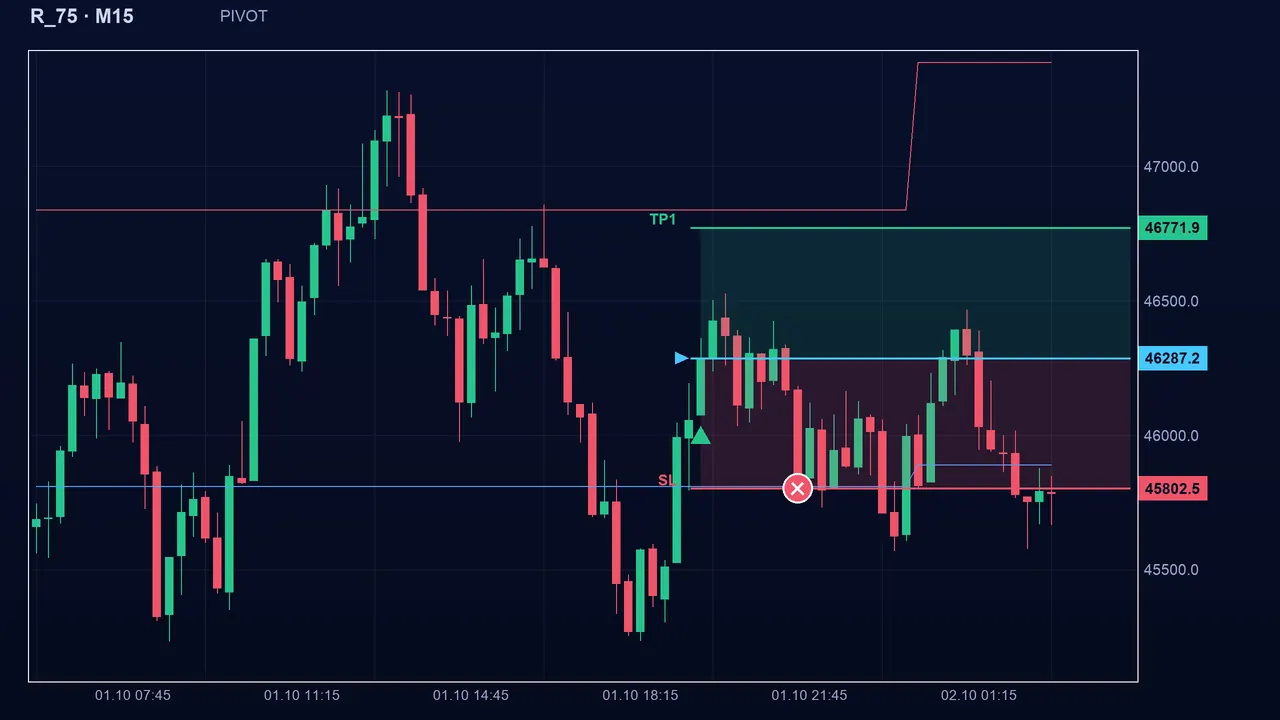
The levels are mechanical: they know nothing about news or context. On Boom and Crash, a spike creates an extreme H or L, and the next day’s levels end up very far from price. When price lingers around an edge of the CPR, the state keeps flipping.
Key takeaways
- Pivots are computed from the previous completed period (H, L, C) and stay fixed during the next one.
- CPR: a close above TC = bullish, below BC = bearish, inside = neutral. Camarilla: breakout of H4 / L4, bounce on L3, rejection on H3.
- A narrow CPR is not a guarantee of a trend: watch for back-and-forth around the edges.
- Combine them with a trend (MA 200) or a structure zone before acting, and always keep a stop.
📝 Lesson test
Log in to take this lesson’s test. Once you have passed all the tests, you will receive a certificate in your name.
Log inThese lessons are for understanding and are not investment advice. No method guarantees winning.