
What is the Chandelier stop for?
The “Chandelier” (Chandelier Exit) is a stop that “hangs” from the recent high, like a chandelier from a ceiling. It lets price breathe in a trend while cutting the position if the market drops clearly from its peak. In Algo Signals, the “Chandelier” method (chandelier) borrows its calculation to set the stop, then places the targets as multiples of the risk.
How the levels are calculated
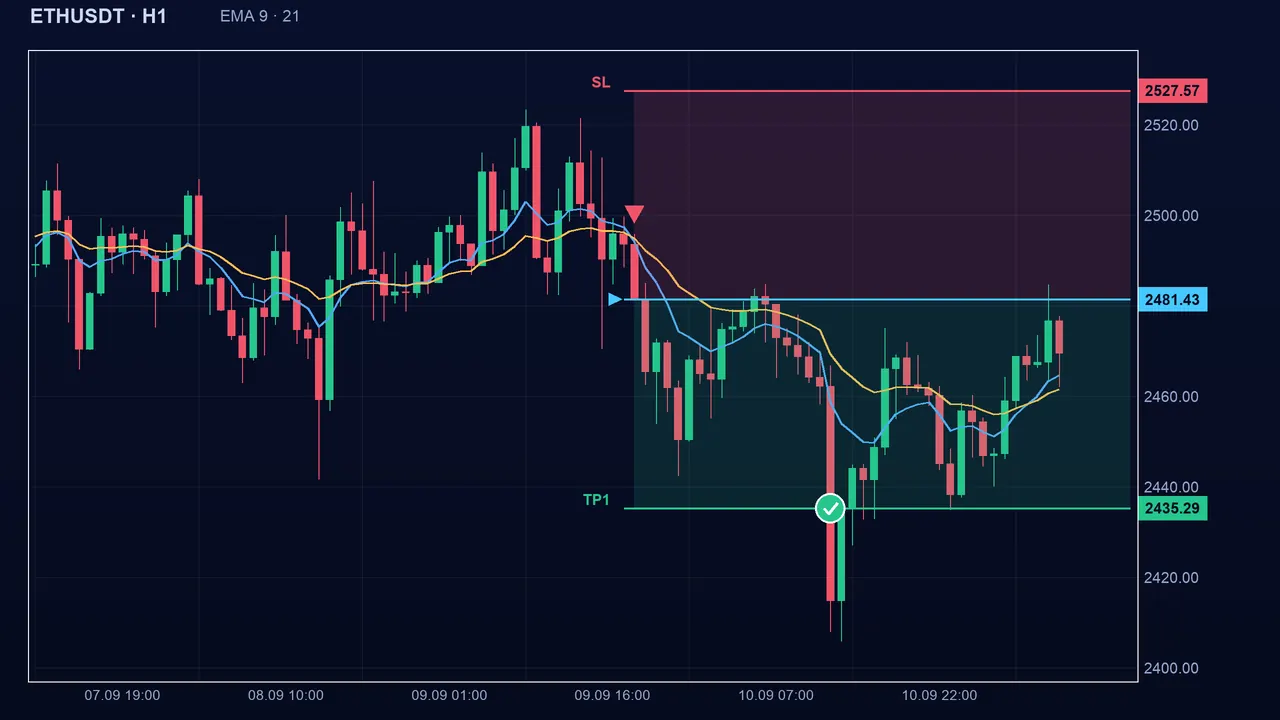
Buy: SL = highest high of the last cdN candles (22 by default, signal candle included) − slMult × ATR (3 by default). Sell: SL = lowest low of the last cdN candles + slMult × ATR. The risk is the distance between entry and stop; TP1 = entry + risk × rr1 (1) and TP2 = entry + risk × rr2 (2). The ATR is the average size of a candle over 14 candles.
Two remarks. The level is calculated once, when the signal appears: it does not follow price afterwards (the classic Chandelier does rise with price). And since the entry is the candle’s close, it is always below the high: the risk of a buy therefore never exceeds slMult × ATR. If the stop is closer than 0.1 ATR to the entry or on the wrong side, the method falls back to the ATR.
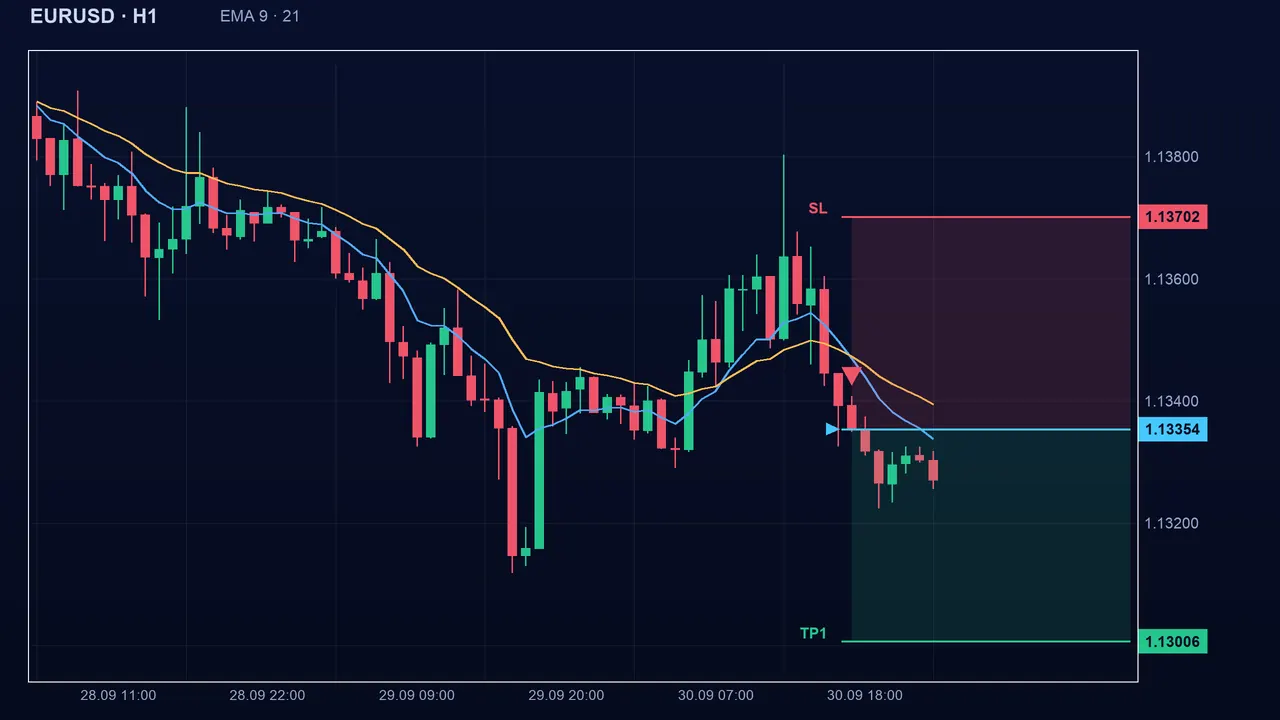
Reading a signal with this method
If price falls back to 2,653.20: −1R (about −$10 if you risk $10, i.e. a size of 10 ÷ 11.30 = 0.88 units). If it rises to 2,675.80: +1R, then TP2 at 2,687.10 is worth 2R. The stop is closer the farther the entry is from the recent peak.
The settings
- cdN (default 22, from 2 to 200): number of candles used to find the reference peak (or trough).
- slMult (default 3, from 0.5 to 20): distance below the peak, in ATR. Smaller: tight stop, quickly hit. Larger: wide stop, heavier loss.
- rr1 (default 1) and rr2 (default 2): targets as multiples of the risk.
- Safeguards (shield): they can set a maximum stop in ATR or a minimum TP.
The pitfalls
Key takeaways
- Chandelier = stop 3 ATR below the highest high of the last 22 candles (sell: above the lowest low).
- The level is fixed when the signal appears; it does not follow price.
- The risk of a buy never exceeds slMult × ATR; fallback to the ATR if the entry is too far below the peak.
- Targets as multiples of the risk (1 and 2); check they remain realistic in ATR.
📝 Lesson test
Log in to take this lesson’s test. Once you have passed all the tests, you will receive a certificate in your name.
Log inThese lessons are for understanding and are not investment advice. No method guarantees winning.